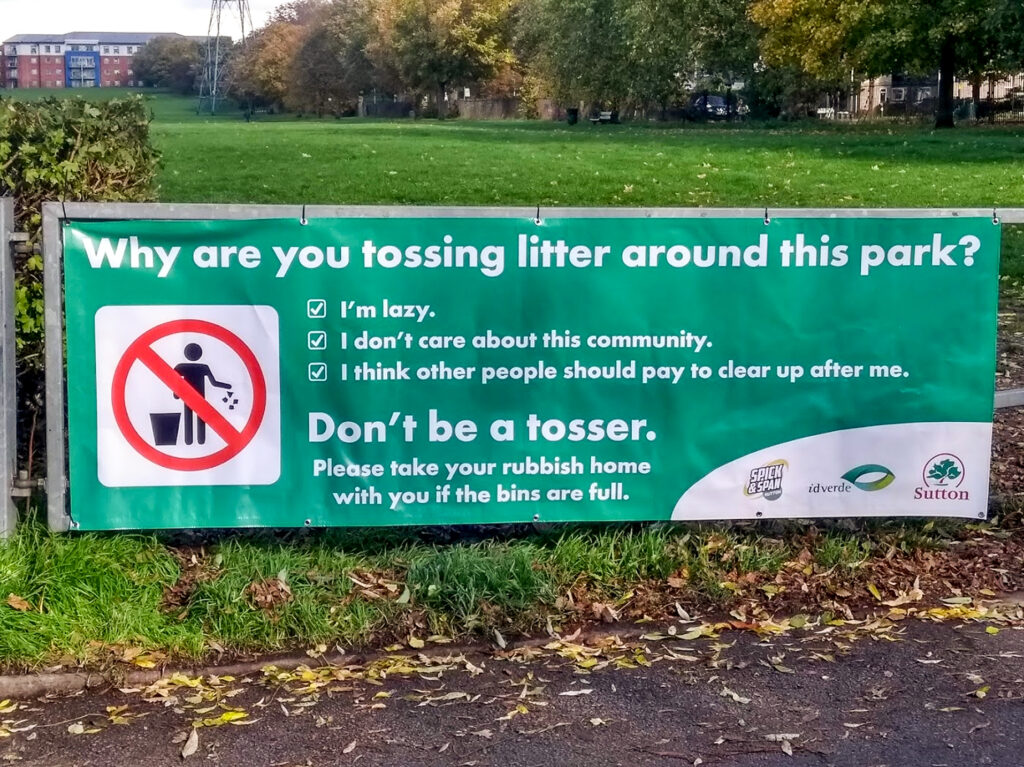
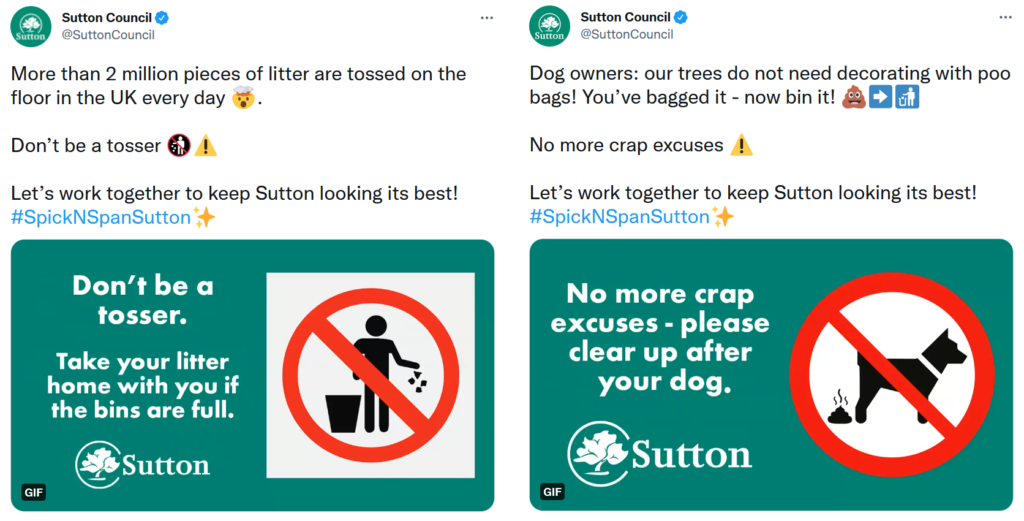
Sutton Council’s corporate strategy ‘Ambitious for Sutton’ provides a vision for the borough aimed at making it a great place to live, work, and raise a family. The Council encourages its residents to be active citizens and aims to reduce litter and fly-tipping by effectively managing the borough’s street cleaning contract. The strategy aims to deliver a programme of education to encourage people to look after and take pride in their local area, backed up with appropriate enforcement measures.
What were the issues in Sutton?
In 2020, the Council found that there was increasing concern about the standard of street cleansing and litter in parks, in part due to increased demands on already busy parks and contractor performance being negatively impacted by COVID-19.
Sutton’s residents and park users were increasingly frustrated and concerned about littering and fly-tipping. Overarchingly it was seen as the Council’s job to deal with these problems.
In the past, the Council’s response to reports of litter, recently compounded by household waste being deposited in park litter bins, was to increase bin provision. This approach, however, meant that the contractors were struggling to complete their collection rounds, leading to reports of overflowing bins and more litter.
It was clear that a new approach was needed, with the following key objectives:
- Improve cleanliness of streets and parks.
- Improve resident satisfaction and reduce complaints.
- Increase residents’ awareness of street cleansing standards and reporting methods.
- Develop effective communications and engagement materials to encourage residents to pride in the borough.
- Take targeted action to tackle offenders.
A parks volunteer coordinator was employed to work with residents and user groups to encourage participation, and the Council ran various cleanliness campaigns, with messages such as “Don’t be a tosser” and “No more crap excuses”.
In addition, a more strategic approach to bin location was adopted. Some bins were removed completely and new covered-style bins prevented wind and wildlife pulling litter out of them. ‘Smart’ compactor bins (which report on fill levels) were also installed in targeted locations. On the streets, digital solutions were installed, such as sensors in bins that monitor capacity and pass information to managers and contractors, and new types of enforcement contract were trialled.
Trialling various approaches
In 2019, ten ‘smart’ bins were trialled on Sutton High Street, replacing 21 standard bins. Whilst the levels of street cleanliness have not been affected, the results have been impressive:
- in the first four weeks of the trial, 43,949 litres of waste were collected, representing a 90% reduction in collections; and
- the street scene was improved and decluttered.
Sutton also trialled new ways of litter and waste enforcement in parks through a contract with WISE (Waste Investigations Support & Enforcement) that started in May 2021, and similarly on streets with Kingdom Services Group in autumn. These trials had the following expectations:
- It would be a zero-cost model.
- The main focus of Fixed Penalty Notices (FPN) would be on littering.
- 5,000 FPNs to be issued in a 12-month period, equating to 12-fold increase.
- Five to eight dedicated officers for streets.
- Commuter hubs to be targeted at peak footfall times.
- Litter hotspots and remote locations to be targeted.
- Dedicated monthly blitzes in hotspots.
The contract with WISE covered these main areas:
- Providing guidance, signage, and permits for using Sutton’s free car parks. Enforcement focused on ensuring that cars parked in designated bays.
- Providing education and penalty issuing for littering and fly-tipping in parks.
- Enforcing sports pitch bookings, model aircraft flying byelaws, dog fouling, and dog control.
- Patrolling of all parks within the borough.
Outcomes and learning points from the trial
Due to a lack of clarity about the legislation status, the byelaw and dog fouling was not enforced during the trial. There were fewer fines issued than expected, with four FTE (fixed-term equivalent) officers on shifts at peak season.
Between an eight-month period, 1,254 FPNs were issued for littering with 880 of them paid immediately, generating around £132,000 from environmental fines towards enforcement costs. In addition, Penalty Charge Notices (PCNs) issued between June 2021 and January 2022 generated £16,500 of income. It was, however, deemed not financially viable for WISE to continue the contract.
Key learning points from the trial with WISE were:
- to check the legislation your Council has in place and the level of fines that have been set by committees;
- complaints, disputes and review of cases should be handled swiftly by the contractor;
- to keep the public on board and ensure tickets issued for offences are fair and reasonable and decide in advance which offences are to be ticketed and at which sites;
- to provide clear signage on what is allowed and what will result in a ticket;
- to focus the contractor on agreed outcomes and methods, by ensuring the Council has the final say on whether any ticket stands; and
- to consider the scope of the contract—self-financing contracts might benefit from a wider scope.