In 2017, Keep Britain Tidy partnered with Parks for London to research and trial new behavioural interventions to address litter from picnicking. The trial took place in four London parks, including Finsbury Park, the largest park in the London Borough of Haringey.
The Abandoned Picnics project aimed to illustrate the cost of cleaning up litter in parks to those using them using posters displayed around the park during summer 2017. By the end of the intervention phase, litter in Finsbury Park was reduced by 32%.
Following the pilot, Haringey Council’s parks service worked with counterparts at the North London Waste Authority to review how waste is recorded and dealt with so as to refine the methodology.
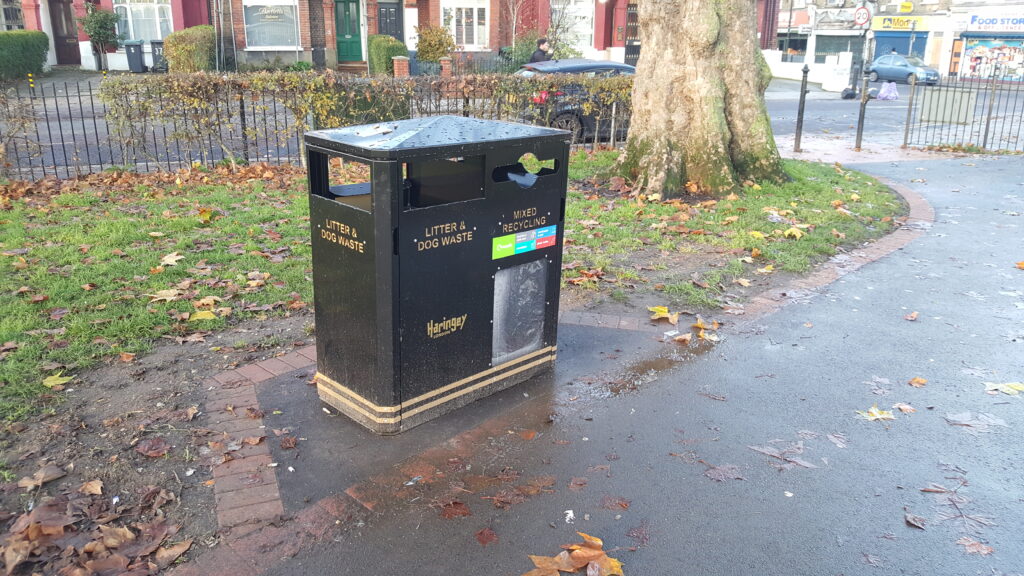
Upon closer inspection of the figures for load amounts, types of waste, and how the data is recorded, the parks team redesigned their standard bins to include capacity for recycling and accepting dog waste along with general waste.
To encourage use of the new bins, they removed the old dog waste bins and found that the new bins were used more than the old bins. This could suggest that people might have found lifting a potentially dirty lid on the old bins off-putting. Perspex panels were used in the design to aid the public in identifying the recycled elements already in the bin and adding to it rather than be confused and not recycle at all.
As part of an action plan, Haringey provided training for waste operatives to identify the level of contamination of recycled waste, which determines which waste processing facility it is sent to. The plan will culminate in the purchase of electric vehicles with dedicated sections for general and recycled waste to simplify disposal at the designated waste centre.
The parks service also invested in eight 1,100-litre bins in Finsbury Park, which usually experiences a high volume of waste, particularly from picnics. Despite an initial increase in fly-tipped waste and household waste appearing in these bins, a review of their locations has seen a marked reduction in the amount of litter left in the park.
Other issues with using these large capacity bins include:
- charcoal from barbecues not fully extinguished before being thrown in, causing fire damage to the bins;
- rough sleepers using the bins as additional shelter;
- graffiti defacing the bins; and
- being used for horseplay by young people.
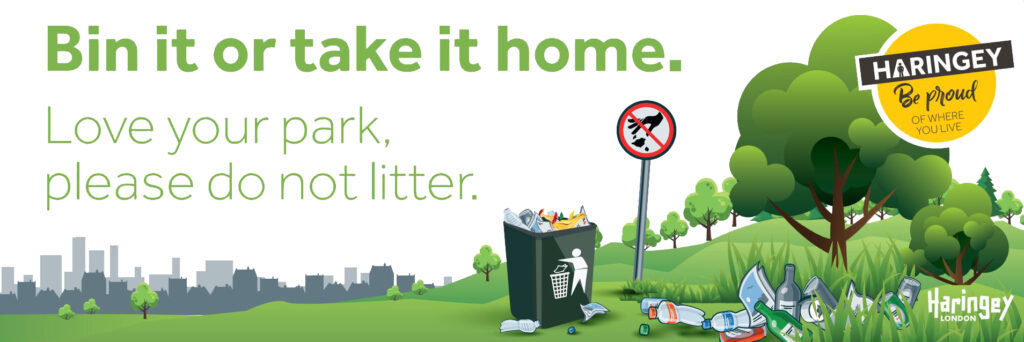
The pilot also inspired the Council to develop their own campaign, Bin it or Take It Home, during the lockdown in 2020 when waste increased exponentially across all the borough’s parks and green spaces.
The campaign slogan was printed on banners erected at all key entrances and locations, and printed on stickers designed for all styles of bins with an additional request to not leave bagged waste next to bins. While impactful at the start, the team reflected on the need to use multilingual signage and posters in the publicity during future campaign runs.
The campaign also included the installation of five skips in the middle of one of their key parks, Ducketts Common, with each skip filled with one day’s worth of waste collected from neighbouring parks over a five-day period. This was a visual demonstration of some of the volume of waste that the parks operation team was dealing with on a daily basis, and many members of the public were dismayed by the revelation that 85 tonnes of waste were moved in just five days—the equivalent of 12.5 adult African elephants!
Within this time, the Council formed a Waste Management Reduction Working Group, tasked to enact the action plan set out in Haringey’s new Parks and Greenspaces Strategy, due to be to be ratified in spring 2023 and covering the next fifteen years. This has highlighted a need for increased staffing and resources.
The pilot has encouraged Haringey to continually test new ideas, the latest of which being the installation of 1,100-litre bins in key parks over the summer in 2022 as well as the installation of grit-style bins for litter and bagged picnic waste.