New ‘Clean Parks for London’ campaign

A pan-London initiative that brings together the green space sector to tackle litter in our parks

Parks for London and 17 other organisations including the Mayor and nine local councils have joined together to launch a new campaign, ‘Clean Parks for London’, starting April 2022 with a simple ask for Londoners and visitors to keep our parks clean.

Led by Parks for London, an independent charity and Centre for Excellence for green space management, the pan-London campaign aims to tackle this unsightly and costly problem by encouraging park users to be part of the solution, by simply taking home what they bring with them.

Litter’s heavy cost

The cost of litter collection and disposal for London’s parks and green spaces alone is estimated to be in the region of £14.8 million per annum, based on results from Parks for London’s recent survey of London’s local authorities. This figure is likely to be upwards of £16 million when considering the costs incurred by other landowners, not to mention the indirect costs associated with impacts on business activity and tourism from sullied environments in badly littered areas.

Beyond the financial toll, littering has environmental and public health implications too [1]. Litter disposed with bin waste cannot be recycled and either ends up in landfill or is incinerated, becoming a source of environmental pollution affecting water, soil and air [1, 2]. Improperly discarded litter not only attracts vermin and can spread diseases [3], it can also find its way into waterways, rivers and oceans [4, 5, 6], harming wildlife, people and ecosystems.

Research shows that high levels of litter can make people feel unsafe and dissuade them from enjoying public green spaces for among other things exercise and stress relief [7, 8, 9, 10], thereby undermining their physical and mental health and wellbeing [11].

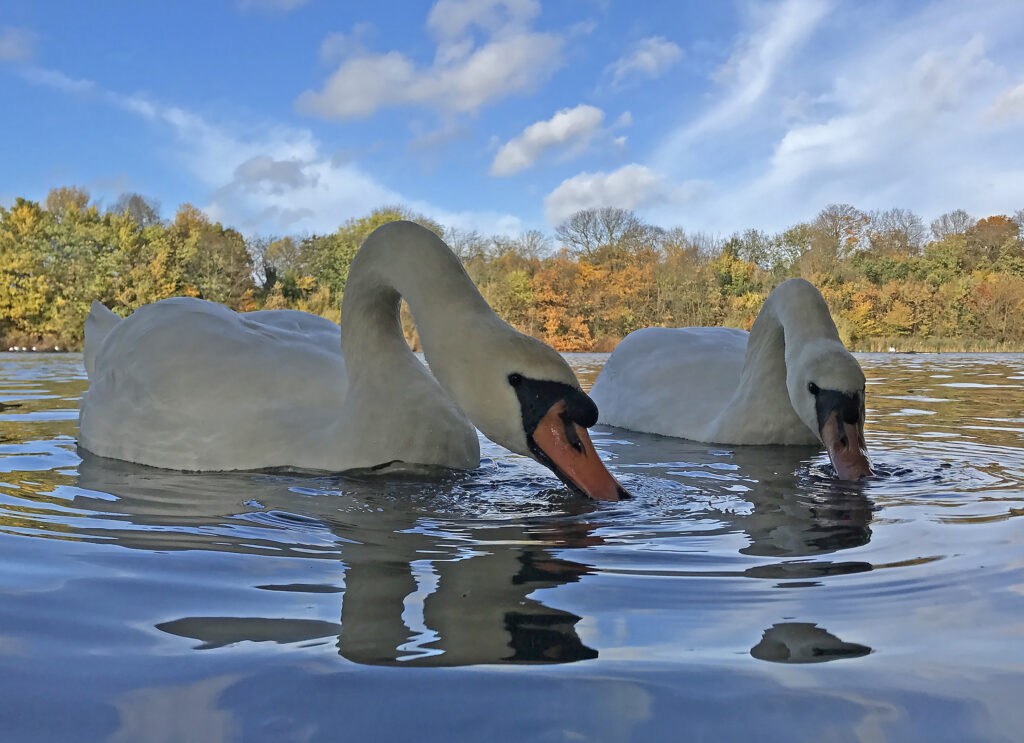
Swans in Leg O'Mutton Lake, London Borough of Richmond upon Thames / Andrew Wilson

Rise of litter

During the pandemic, people turned to their local parks in droves for exercise or solace and relief from stressful situations [12]. However, this increased footfall led to unprecedented levels of litter and waste, putting an additional strain on already stretched budgets and workforce. Keep Britain Tidy’s 2020 survey of over 100 local authorities in England revealed that 81% had to increase spending to keep litter in check [13].

Given that untidiness in public spaces itself can cause further littering and other anti-social behaviours or crimes in what researchers refer to as ‘the spreading of disorder’ [14, 15], interventions that reduce littering by the slightest amount could reap big societal benefits [1].

Litter strewn across London Fields in London Borough of Hackney / Hackney Council

Taking down litter

As the spring holidays approach, London’s landowners and managers will be gearing up for increased parks visits and a corresponding rise in littering. Despite differences in how littering is managed and enforced within their managed spaces, partners will progressively adopt a unified message on litter under the ‘Clean Parks for London’ campaign starting this spring.

This campaign builds upon Parks for London’s active work on litter and waste management where parties with an interest in reducing litter within their parks and green space have come together to discuss localised litter issues, share best and innovative practices and strategies, with the aim of reducing litter and associated costs and changing public behaviour towards litter.

Tony Leach, Chief Executive of Parks for London, said: “We all love using our parks when they’re looking clean and tidy but seeing litter spoils it for everyone. Littering is antisocial and puts people off using parks. Clearing up litter costs time and money, and who pays? Every person who pays council tax pays for litter clearance. Wouldn’t you rather see that money spent on making your parks better? We hope that this campaign will encourage more and more people to take responsibility for their rubbish, so that the money saved from litter collection and disposal can be better spent on park improvements. Please be an influencer and take your rubbish home, thank you.”

Deputy Mayor for Environment and Energy, Shirley Rodrigues said: “The COVID-19 pandemic highlighted the vital importance of London’s green spaces for Londoners’ health and wellbeing. Litter not only directly impacts people’s ability to enjoy our wonderful parks, but also affects wildlife and pollutes our waterways. It is everyone’s responsibility to respect these fabulous spaces. The simple act of taking litter home and disposing of it responsibly means we can all appreciate the benefits these spaces provide.”

See more on the campaign on our social media platforms, and use the hashtags #CleanParksforLondon and #KeepParksClean to spread the message. If you are keen to join the campaign, please contact us here.

Additional Quotes from Supporters

Vince Buchanan, Head of Parks, Sport and Leisure at Lewisham Council, said: “As well as the daily cleansing work carried out by our contractors, Glendale, we are extremely lucky to have such active volunteer Friends groups who provide added support in litter picking activities in our Parks and Open Spaces. During the recent lockdown we saw significant increase in parks usage and with that greater incidences of littering and additional pressures on budgets for this. We therefore want to push the message of preventing littering in the first place and we hope this pan-London campaign will encourage Lewisham residents to continue to enjoy their beautiful open spaces but raise awareness of how all park users can take responsibility to help to keep them that way.”

Councillor Neden-Watts, Chair of Environment Committee at Richmond Council, said: “Richmond Council is famous for its many open spaces, extensive network of green routes and its 21 miles of footpaths and green areas on the banks of the Thames which are well used and highly valued by residents and visitors. High visitor numbers often result in an increase in the amount of litter left in our borough, particularly on sunnier days.

We continue to collect the litter deposited in our parks and along the towpath, but the cost of this is enormous—we need everyone to help tackle the problem. It’s wonderful to see people enjoying parks for picnics, sports and socialising and we encourage people to dispose of their waste correctly. If bins are overflowing, they will be emptied—in the meantime, find an alternative bin or take items home and recycle where possible.

Excessive litter makes parks unpleasant for people, and it harms wildlife. Council Taxpayers are funding a clean-up operation costing millions of pounds a year. If people make sensible choices about their waste and behaviours then we will not have to spend such vast sums clearing up.”

Mark Camley, Executive Director of Park Operations and Venues at Queen Elizabeth Olympic Park, said: “London boasts some of the best open spaces in the world and it is a reputation we are rightly proud of. Queen Elizabeth Olympic Park is one of the newest additions to our open spaces but we face the same challenges as our more mature neighbours. Despite the excellent work of our dedicated Park team we still need visitors to take responsibility for what they bring to the park and what they leave. I believe firmly, that visitors should look to take away what they bring. Raising awareness and working with other parks to re-enforce this message really helps us to encourage visitors to act positively. We know that during lockdown parks were a lifeline—here in east London many people live in flats with no access to gardens. Our parks deserve to be treated as the lifeline that they are.”

Ted Inman, Chair of the Jubilee Gardens Trust which manages Jubilee Gardens on London’s South Bank, said: “As one of the busiest and best-loved green spaces in Central London we provide essential space to play and relax for South Bank residents, local workers and visitors alike. In the South Bank area 70% of residents don’t have access to a garden, with parks such as Jubilee Gardens offering green space for exercise and access to nature which has such a benefit for mental health.

Unfortunately, as lockdowns ended in 2021 the Gardens saw a huge increase in litter at a time when the Trust’s funds had been significantly impacted by the pandemic. Not only was this litter a shocking eyesore but an environmental tragedy and upsetting for Jubilee Gardens visitors and staff alike. For our small locally based charitable trust comprising representatives of residents, businesses and adjacent landowners, the cost of hiring additional staff to clean and clear rubbish, along with waste disposal, put an increased strain on our finances.”

Mark Evison, Park Manager at Alexandra Park & Palace, said: “London’s parks are pretty unbeatable, especially when the warmer weather gets here. We’re delighted to have welcomed record numbers to our park over the last couple of years, but a downside is that more people has meant more litter. It’s not too difficult to find a bin, or even better, take your litter home with you. We know people are becoming more environmentally aware and we’d love to see this in action in our park, and those across London, this spring and summer.”

Gareth Winn, Ranger Service Team Leader at Barking & Dagenham Country Parks, said: “Litter and fly tipping in our parks has increased drastically since the pandemic. Please be part of the solution, not the problem and use the bins provided or better still, take your litter home. Help keep our parks across London clear of rubbish for both people and wildlife.”

The Bankside Open Spaces Trust Parks Team said: “Bankside Open Spaces Trust is delighted to be part of Clean Parks for London. A city-wide campaign focusing on litter and waste is invaluable to teams managing parks and gardens—reducing waste means less time litter picking and more time gardening! Our staff and volunteers build litter picking into our regular park maintenance, and we work closely with our local authorities to address waste issues too. Litter reduction is a collaborative effort, and we’d love Londoners join us in working on Clean Parks for London.”

The team at Chiswick House & Gardens Trust said: “The Pandemic saw a significant increase in visitor numbers at Chiswick Park & Gardens, serving a much- needed community sanctuary. Unfortunately, with rising numbers we also saw a rise in litter. Our staff and Volunteers have approached this hands-on, putting in hours to ensure a clean and tidy green space. Some of the initiatives that we have taken include working with We Parks London for their 2020 campaign to educate the community and promote the message Please be kind to our local parks. This message continued beyond the campaign; we reduced the number of litter bins on site, encouraging visitors to take their litter home; we also worked with the Café on our grounds to organise an effective and sustainable method of recycling coffee cups. All this hard work has paid off, with visitor numbers remaining high but the volume of waste returning to what it was pre-covid.

We are grateful to be part of this campaign, as the work towards having a waste-free park is far from over.”
Citations

  1. Bateson M, Robinson R, Abayomi-Cole T, Greenlees J, O’Connor A, Nettle D. Watching eyes on potential litter can reduce littering: evidence from two field experiments. PeerJ. 2015 Dec 1;3:e1443.
  2. Chaudhary AH, Polonsky MJ, McClaren N. Littering behaviour: A systematic review. International Journal of Consumer Studies. 2021 Jul;45(4):478-510.
  3. Battersby SA, Parsons R, Webster JP. Urban rat infestations and the risk to public health. Journal of Environmental Health Research. 2002;1:57-65.
  4. Davey S. Plastic ‘Highways’ to the Sea: The Problem of Litter in English Inland Waterways. Social Sciences. 2021 Dec;10(12):473.
  5. Schmidt C, Krauth T, Wagner S. Export of plastic debris by rivers into the sea. Environmental science & technology. 2017 Nov 7;51(21):12246-53.
  6. Jambeck JR, Geyer R, Wilcox C, Siegler TR, Perryman M, Andrady A, Narayan R, Law KL. Plastic waste inputs from land into the ocean. Science. 2015 Feb 13;347(6223):768-71.
  7. Yang Y, Lu Y, Yang H, Yang L, Gou Z. Impact of the quality and quantity of eye-level greenery on park usage. Urban Forestry & Urban Greening. 2021 May 1;60:127061.
  8. Gobster PH. Managing urban parks for a racially and ethnically diverse clientele. Leisure sciences. 2002 Apr 1;24(2):143-59.
  9. van Vliet E, Dane G, Weijs-Perrée M, van Leeuwen E, van Dinter M, van den Berg P, Borgers A, Chamilothori K. The influence of urban park attributes on user preferences: Evaluation of virtual parks in an online stated-choice experiment. International journal of environmental research and public health. 2021 Jan;18(1):212.
  10. Arnberger A, Eder R. Are urban visitors’ general preferences for green-spaces similar to their preferences when seeking stress relief? Urban Forestry & Urban Greening. 2015 Jan 1;14(4):872-82.
  11. Britain G. Government review of waste policy in England 2011. Department for Environment, Food and Rural Affairs; 2011.
  12. Dobson J. Wellbeing and blue‐green space in post‐pandemic cities: Drivers, debates and departures. Geography compass. 2021 Oct;15(10): e12593.
  13. Keep Britain Tidy. New campaign launched in face of littering epidemic in parks [Internet]. 2020 Jul 24 [cited 15 March 2022]. Available from: https://www.keepbritaintidy.org/news/new-campaign-launched-face-littering-epidemic-parks
  14. Keizer K, Lindenberg S, Steg L. The spreading of disorder. science. 2008 Dec 12;322(5908):1681-5.
  15. Weaver R. Littering in context (s): using a quasi-natural experiment to explore geographic influences on antisocial behavior. Applied Geography. 2015 Feb 1;57:142-53.

Download the media release

Find out more about the campaign

We only use strictly necessary cookies, cookies that are required for the operation of our website. Carry on browsing if you're happy with this, or find out how to manage cookies on our Cookie Policy page.