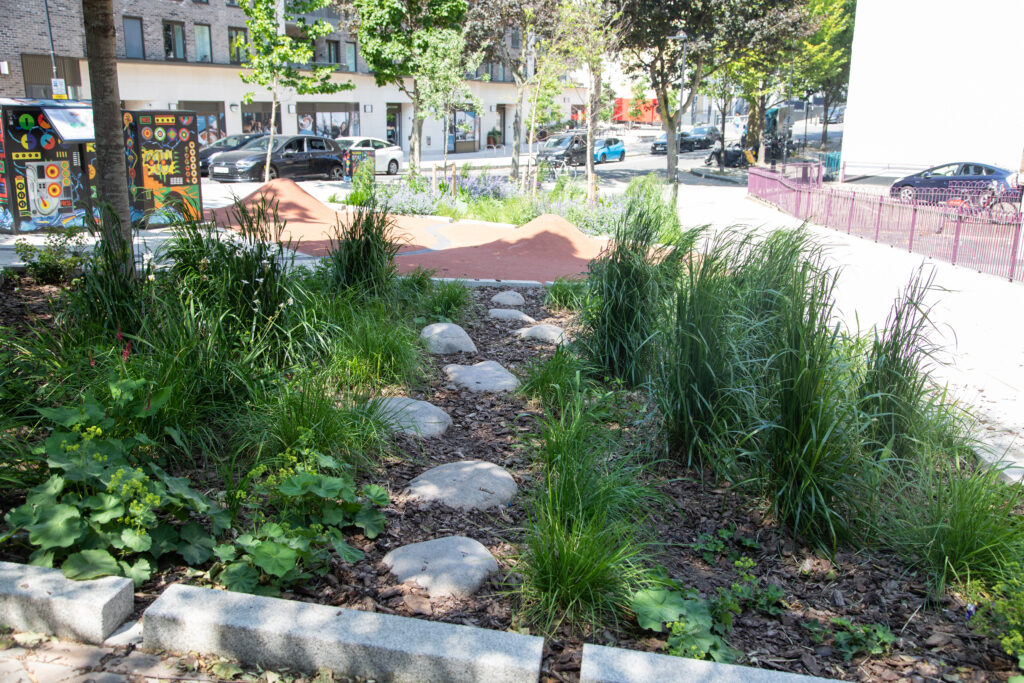
The Fleet Valley Pocket Park completed in 2022 sits above the historic route of the River Fleet that once flowed through Camden from Hampstead Heath and down to the River Thames. Formerly an underused area of concrete paving slabs, the Council sought to convert this area into a multi-functional pocket park to provide an urban oasis for residents to sit and socialise, or quietly enjoy nature.
The site, located in Central London, was recognised within Camden’s Local Plan as an area deficient in access to nature and open space. The Holborn and Covent Garden ward has low canopy cover and is more susceptible to the impacts of climate change, such as heat risk and surface water flooding, and it falls under the greatest risk category in the Greater London Authority Climate Risk Map. High-density housing surrounds the pocket park area, and the majority of the residential towers are without balcony space, meaning access to a useable doorstep open space is in critical need. The site had also historically suffered from anti-social behaviour and Camden Council’s street cleansing service had identified it as a fly-tipping hot spot.
To address these multiple challenges, Camden Council carried out detailed public engagement within the area in 2019. Working with the Mount Pleasant Neighbourhood Forum, they identified a set of priorities for the new design. These included providing a green and biodiverse space, incidental play, a place to relax, a robust landscape, and references to the River Fleet; responding to the topography; designing out anti-social behaviour; and building on the aspirations of the neighbourhood plan. The priorities were then used to inform the design brief and landscape architects Land Use Consultants (LUC) were procured to take the design to RIBA stage 4.
The pocket park was developed with careful consideration for its local context. The planting palette produced by LUC placed a particular emphasis on nectar-rich biodiverse species to bolster the native wildlife and provide a stepping-stone habitat within central London. A blue brick explorer path meanders through the site, evoking the flow of the historic river, accompanied with an engraved poem about the River Fleet that further echoes the local history of the site.
The local community was heavily involved in the development of the pocket park, with the Neighbourhood Forum providing feedback and oversight across all stages of the project. This included specific contributions such as the name of the site, Fleet Valley Pocket Park, which the community felt would help give the space a new sense of identity. The local community further embedded their stamp on the final design, by providing the content for the engraved poem on the brick explorer path.
The local primary school which uses the pocket park as its drop-off and pick-up area also contributed to the project. This included temporary artworks on the paving of the area prior to commencement of the main works, as well as the introduction of permanent brass roundels that are inlayed into the hard standing of the completed pocket park. A local artist was also commissioned to produce artworks for the large electrical feeder pillar cabinets, to turn a mundane item of public realm utility into a series of colourful artworks that further celebrate the theme of the lost river.
To alleviate local flood risk, a Sustainable Drainage System (SuDS) attenuation feature was installed to capture surface water run-off from the surrounding pavements, supported by large areas of permeable paving further reducing run-off rates. The combined water storage capacity of the features is 40m3, helping to significantly reduce the pressure on the surrounding Thames Water drainage network. Recognising the benefit to the drainage network, Thames Water funded the SuDS element of the project through their Surface Water Management Programme. Four new trees were also planted at the site to better intercept rainfall and provide shade, each with substantial tree pits below ground that will enable the trees to reach maturity and deliver maximum ecosystem services.
Since the scheme’s completion in 2022, the pocket park has transformed a forgotten corner of Inner London into a thriving, multi-functional green space that delivers a multitude of social and environmental benefits. The pocket park’s ability to mitigate local flood risk, as well as the amount of biodiverse planting are quantifiable, and the benefits and uplifts around social value (though harder to measure) are clearly visible, such as a greater sense of local identity and increased outdoor activity amongst younger residents.
The benches in the pocket park are being well used, particularly at school pick-up and drop-off times, helping to activate the space and bring life and vibrancy to the area that was previously unused and without purpose. The incidental play features are enjoyed by local children, making the pocket park a hub for them to play safely, without the need for a formally designated ‘play area’ with associated inspection regimes. Fly-tipping is also no longer an issue at this well-visited site, and there have been no reports logged of anti-social behaviour taking place in the last year.
The Council is initiating a borough-wide programme of highways greening, seeking to deliver similar schemes in areas of the borough where pocket parks and green infrastructure measures will generate the most benefit, focusing on areas deficient in access to open space, as well as communities that are more susceptible to the impacts of climate change.
Designed in partnership with the local community, seeking to address the multiple challenges that residents in high-density areas face, as well as celebrate the distinctive local character and history that makes an area special, Fleet Valley Pocket Park serves as an important case study on what can be achieved in a relatively small area when approaching highways improvements from a place-based approach to design.
Contact
Joe Lewis
Green Space Project Officer
Joe.Lewis@camden.gov.uk