Capel Manor College is London’s only specialist environmental college, offering a diverse range of full and part-time courses in further and higher education for young people and adults, while embracing and promoting inclusivity in land-based careers.
Capel Manor has six campuses which cover over 200 acres of land. These sites include two zoos, a city farm, an organic working farm and two animal collections, housing over 1,500 live animals. As part of their studies, students have the unique opportunity to obtain real-world experience and help take care of the College’s estates and commercial businesses.
The College plays a vital role in pushing the green agenda for the capital through education and equipping the next generation of land-based sector workers with the skills and knowledge needed to help preserve and protect London’s wildlife, parks, and green spaces.
Capel Manor College contributes to conservation by producing surveys to monitor local wildlife; actively choosing greener tools to work with and encouraging students to take part in eco trips both in the UK and abroad to give their time to projects that need support.
As part of this vital work, the College’s Animal Management department is working with students to protect the rarest and most threatened mammal in the UK, the Scottish wildcat.
What is the Scottish wildcat?
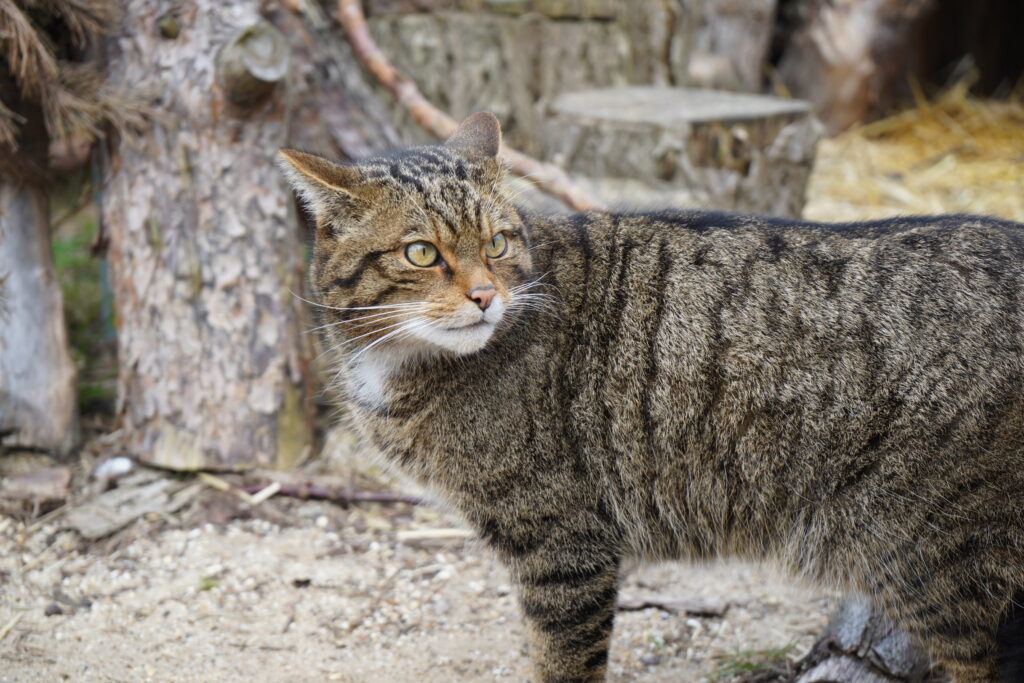
The Scottish wildcat (Felis silvestris silvestris) is a European wildcat subspecies that is found in the Scottish Highlands. Historically they lived across Britain but are now on the brink of extinction and found only in parts of Scotland.
In 2007, they became listed as a priority species under the UK Biodiversity Action Plan, and protected under UK and European law and the Convention on International Trade in Endangered Species (CITES).
Why are Scottish wildcats an endangered species?
In 2018, the IUCN Species Survival Commission (SSC)’s Cat Specialist Group—a science-based network of more than 9,000 volunteer experts from almost every country of the world—carried out an independent review of the conservation status of the Scottish wildcat. Due to hybridisation, disease and accidental persecution, the Group concluded there was no longer a viable wildcat population living wild in Scotland. Captive breeding and working towards ‘safe release sites’ are now the only hope for this critically endangered species’ survival.
Capel Manor College’s role in preserving the Scottish wildcat
In 2017, the College worked with the studbook holder and the charity Saving Wildcats to welcome its first-ever Scottish wildcats, Nevis, and Monroe, to its zoo based at its Enfield Campus in North London. These cats are both ambassadors for their species and play a vital role in educating future keepers and conservationists.
This year, the College will be growing its capacity to keep more wildcats at its animal collection on its Mottingham Campus which will enable a wider audience to see this rare British species and be educated on the importance of conserving them.
Alongside other dedicated researchers, Dr Nikolaos Karantanis, lecturer at Capel Manor College, is leading the way to ensure the fate of the European wildcat—the only wild feline in Greece—does not succumb to the dismal fate that has been seen with other local wildcat populations across Europe and the UK.
Wildcat Project Greece aims to contribute to understanding the ecology and conservation of wildcats by tracking them in the field. This will be done by collecting data using cameras, radio marking and methods of biomarkers to understand these elusive creatures and is essential when ensuring their survival.
To find out more about studying at Capel Manor College, visit capel.ac.uk.