Hammersmith and Fulham recognise the vital role tree planting plays in creating habitats for a wide range of species, increasing biodiversity, helping with the urban cooling effect, and capturing carbon. To overcome some of the challenges of planting trees in an urban setting the Council began working with residents and Earthwatch Europe in late 2020 to identify a site in the borough to create London’s first Tiny Forest with the sponsorship of local company Fever-Tree.
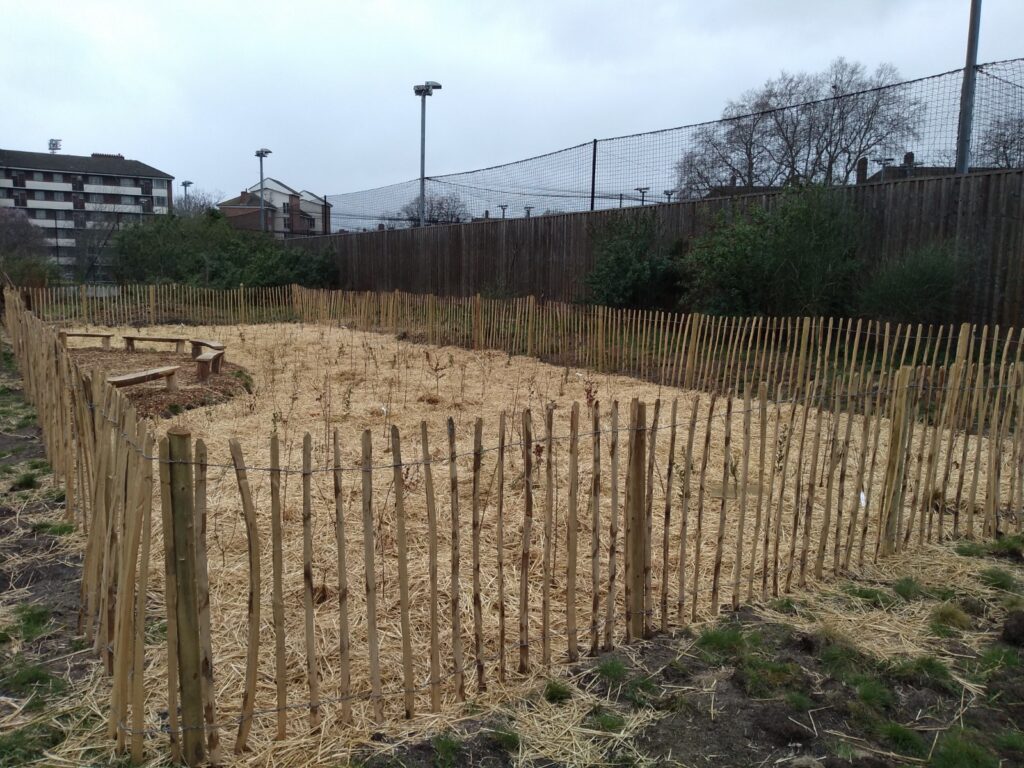
The selected site was a former bowling green in Hammersmith Park which had been inaccessible following the demolition of its pavilion. In early 2021 to regenerate this piece of derelict park land covering 200 square metres, 600 trees were planted using the Miyawaki method. This densely packed forest of 16 native species including oak, holly, and hawthorn, is growing rapidly and will provide a range of canopy heights—from shrub vegetation to trees—and ecological habitats.
The valuable role of parks in mental and physical wellbeing has been emphasised during the pandemic. Not only can the Tiny Forest provide a nature-rich habitat to support wildlife but the Council also hopes it will act as a natural anchor for informal recreation and relaxation and provide the social and environmental support required especially in urban environments. The forest hosts a small outdoor classroom which can be used by charities and school groups now that pandemic restrictions are relaxed.
The forest is monitored and maintained by the Tree Keeper team made up of volunteers, in which Fever-Tree play an active role. Additionally, there are periodic community science days held at the site, where locals can get involved by collecting data through citizen science.
These events provide an opportunity to engage with residents of all ages and reconnect them with nature, as well as provide motivation for positive action towards nature protection. The forest is also capable of enriching biodiversity, attracting over 500 animal and plant species within the first three years, and improving air quality. This nature-based solution will provide much needed sustainable support towards climate resilience in urban areas.