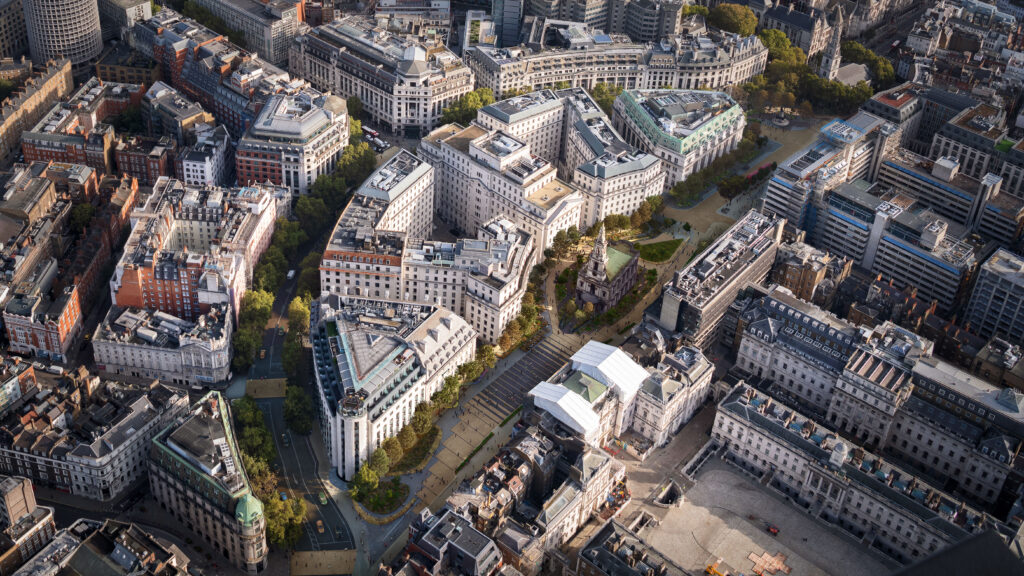
The Strand, a major thoroughfare in the City of Westminster, is notorious for being gridlocked, polluted, and dangerous for pedestrian and cyclists. In 2015, the Northbank Business Improvement District (BID) undertook a public realm study and explored options for improving the public realm in a traffic-dominated environment, both across Aldwych and along a 170m stretch of Strand that was identified for transformation from a four-lane gyratory into a 7,000m2 new public space in London’s West End.
By reclaiming the highly congested gyratory that weaves around the Grade I listed St Mary le Strand Church, through King’s College London, and along Somerset House, the Strand Aldwych project aims to achieve the following objectives:
- better movement of traffic by improving journey times and safety;
- improve the public realm by creating an attractive public space and a better pedestrian experience;
- improve links for walking and cycling to the surrounding area
- improve air quality;
- support culture, education, innovation, and collaboration; and
- support the area’s economy.
The ambitious pedestrianisation project was progressed through feasibility by Westminster City Council, and stakeholder workshops, run with over 70 organisations, in a co-creative process to establish key parameters for concept designs.
A management model was similarly developed alongside the physical designs through a series of stakeholder workshops, setting out these six key pillars: place and identity; operations and maintenance; curation and activation; sustainability; smart, local economy. Working groups were established to agree the vision and work programme, reporting progress quarterly to stakeholder Project Boards, chaired by Somerset House Trust. By developing the designs and the management model concurrently, one could influence the other, both working to the vision to create a “global cultural thinking quarter” for London, drawing on the wealth of content within the surrounding institutions to activate the space.
The project was developed in collaboration with over 100 organisations. Local stakeholders developing the project alongside the project team has been powerful to keep the project place-focused and develop a shared vision and set of values. The strength of this approach is evident through commitment to a governance structure overseeing curated activity and operations.
In addition to the initial £22 million capital investment by the Westminster City Council, a Collaboration Agreement locks in stakeholder and partner funding for the uplift in management costs associated with the new public space, with most of the operational services continuing through council-run contracts. Currently, the Council is working with two financial partners currently contributing a total of £500,000 annually.
The project development was reviewed when the COVID-19 pandemic interrupted ongoing works. In light of a new emerging context, a phased delivery approach for the Strand public space was introduced so that works could begin sooner to support the local economy as quickly as possible, with the added benefit of having the opportunity to test the design and usage of the new public space.
The interim solution that has been delivered uses dressed tarmac finish and off-the-peg street furniture, with the goal of taking the space to its final version—anticipated in high-quality materials with bespoke furniture—and addressing any observed issues that have come up around layout or the space’s use over the next three to five years. The construction works for the first phase reached substantial completion in December 2022 with minimal traffic implications, on this part of Transport for London’s strategic bus network.
The management model will also continue to evolve with stakeholders leading discussions to explore long-term sustainability. The project has already been a catalyst for further change, influencing key building acquisitions and attracting new occupiers, such as the New York University. St Mary le Strand Church has also been successful in a National Lottery Heritage Fund bid to secure its future in its new physical context.
Key Performance Indicators (KPIs) have been developed to measure the success of the space. Data against these will be collected by a dedicated Operations Manager (employed directly by Northbank BID) and a Curation and Activation Manager (employed by Westminster City Council through S106 funding), and fed into Boards to inform decision-making about place and resource allocation (see their Management Governance Structure). An Engagement Strategy capturing users’ experience of the place alongside the KPIs will inform the next stages.
Today, the Strand Aldwych project has created a new destination in London that celebrates the extraordinary cluster of cultural, creative, and educational organisations in this iconic part of London. The new public space includes over 1,370m2 new planted areas, a garden space around St Mary le Strand Church, a large open plaza for flexible activity, and a range of seating options from a collective dining table and workstations, to a rainbow seat.
Contact
Rebecca Cloke
Head of Programme Delivery, Place Shaping
rcloke@westminster.gov.uk