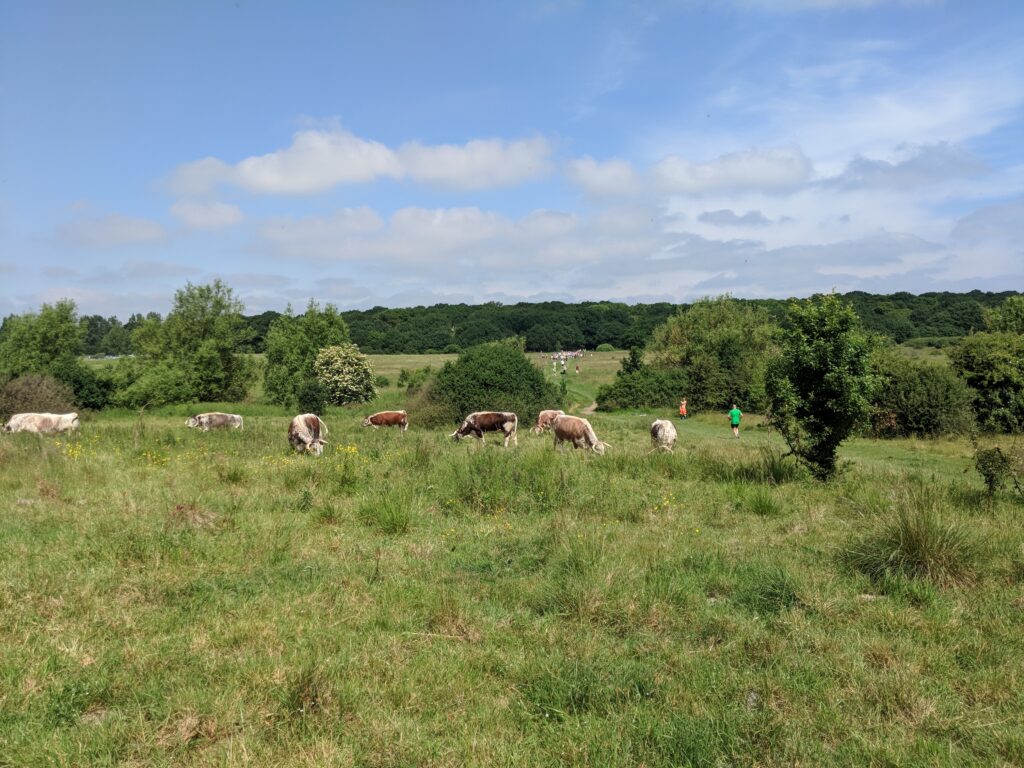
In Epping Forest, cattle roam across the large ancient plains and through the dense thickets of ancient pollards to glades, slades and heaths. These interwoven habitats make up Epping Forest’s diverse wood-pasture landscape for which grazing is vital to its survival.
Distinctive to Epping Forest grasslands are plant species that are finely adapted to grazing and are often spiny or unpalatable or have seeds that require dispersal through the guts of the grazers, such as the petty whin, spiny restharrow, pepper saxifrage and lousewort and cross-leaved heath.
In other areas, the hooves of grazing animals create gaps for fallen seeds to germinate, benefitting the low-growing species characteristic of pasture, including, bird’s-foot trefoil, tormentil, and heath bedstraw.
Cattle grazing also promotes populations of species of flies, beetles, and butterflies. On the drier acid grasslands, bare ground is critical for solitary bees and wasps, many of which are now very rare due to declining grazed grassland.
Historically, cattle were free roaming across Epping Forest but have been contained since 2011 using pioneering invisible fencing technology. As the first to use this technology in the UK, the grazing project at the Forest has continued to innovate in it its use, including the transition in 2020 to GPS-based collars with the assistance of a grant with Rare Breed Survival Trust.
The GPS collar technology enables adaptive management of grazing animals using virtual boundaries which can be modified through a mobile app. Its application allows managers to track animals, receive real time alerts and create heat maps of animal movements.